Eugene Rising, Part II
The Workers, The Racists, and The Vagrants
This is the second edition of a seven-part series on the history of activism and protest in Eugene, Oregon. To start from the beginning, click here.
As you read through this story, you’ll notice a series of formatting choices that, at first, may appear really obnoxious. But don’t worry: this is intentional, and will help you understand the way we’re approaching it.
Here in the middle, where there’s no formatting at all, is where you’ll find the neutral narrative that we’re engaging with throughout the story.
A savvy reader might consider this the closest approximation we, as journalists obsessed with historical documents and public records, could find to an objective truth.
When you see this toxic green color, you’ll be reading the thoughts, musings, and analysis by Editor-in-Chief Nadya Malinowska.
And when you see this pink color that happens to match his protest helmet and nails, you’ll have the thoughts, musings, and analysis by Editor-at-Large James Croxton.
We did this because we believe that it is important to engage with history as we uncover it, and that engaging with history means constantly critiquing it, challenging it, and–when deserved–making fun of it, too.
But we don’t want to make the mistake of passing off those critiques and analyses as objective, since so many people still seem to believe that such a thing exists, and we don’t want to mix our own biases and perspectives with the hard research that we used to put this story together.
Okay, with that out of the way, let’s talk about unions!
The Timberbeast’s Lament:
Organized Labor Comes to Eugene
The earliest known struggle against capitalism and law enforcement started to take shape following the establishment of the Eugene Industrial Workers of the World in March 1912.
The IWW, founded in Chicago in 1905, was a radical labor organization that advocated for “One Big Union” and encouraged direct action and direct democracy to achieve the liberation of the working class. Its members led the first major civil disobedience campaigns in the state and became the driving force behind Oregon’s early leftist tradition.
Though they never reached the notoriety of Portland’s IWW chapter, Eugene’s “Wobblies”–the nickname given to members of the ragtag radical union–quickly took their fight straight to the city.
The Wobblies were famous for their street-level approach to union organizing, and were often found on street corners up and down Willamette Street in downtown Eugene, preaching their gospel of revolution to anyone who would listen. They loved to refer to police officers as “clowns,” which naturally pushed EPD’s buttons and tested the limits of the department’s policy on free speech in public places. The cops attempted to bar the Wobblies from speaking on street corners, but told them they could do so on side streets and alleyways as long as they didn’t break any laws or block traffic.
Nadya Malinowska:
A permit for people to speak in public places? Asking permission from local officials to hold rallies with the express understanding that traffic wouldn’t be blocked and laws wouldn’t be broken? How could the Wobblies operate under such conditions?!
James Croxton:
This reminded me of a Raging Grannies vigil for murdered Black lives that I reported on in Palo Alto, California on July 3, 2020.
Somebody asked about whether they—the Grannies—had a permit to which one of them quipped “The Grannies have never gotten a permit in 20 years! Whose park? Our park!”
Citizens of Eugene rarely had patience for the Wobblies and often harassed them as much as the police. According to Robert Tyler’s book Rebels of the Woods, at least one restaurant in downtown Eugene offered free eggs to anyone willing to throw them at Wobbly street preachers, which, in turn, led to frequent scuffles outside said restaurant between radicals and their local opposition. Lane County even tried to pass a measure that would bar public speaking without mayoral consent, though it was eventually shot down due to outspoken opposition from local newspapers like the Eugene Guard.
Nadya Malinowska:
I have to draw attention to the fact that a downtown restaurant once served as a base for opposition to radical organizing in Eugene–not unlike a certain downtown restaurant today.
Despite staunch opposition from local officials, the Wobblies soon found success in organizing workers at lumber mills and timber camps in the forests outside of Eugene. Their first major action in the area involved organizing a series of wildcat strikes that temporarily halted construction of a railroad outside the city in December of 1912.
But it wasn’t until the outbreak of World War I that the IWW’s organizing really made an impact.
With Europe embroiled in conflict and America wavering on whether to join the fighting, the U.S. government began buying, objectively speaking, a fuck-ton of Oregon timber, which caused prices to skyrocket. This helped owners of lumber mills and logging operations make, objectively speaking, a fuck-ton more money than they already were.
When those sky-high profits failed to trickle down to the workers who cut, transported, and processed the timber, members of the IWW saw an opportunity to raise hell for better wages and an eight-hour workday. Naturally, strikes erupted all over the state, and eventually rose to the level of spiking trees and sabotaging equipment. The U.S. Army had to be called in to secure the timber supply.
James Croxton:
Okay, so, tree spiking really concerns me. Like, I understand how resorting to sabotage could be useful and utilized, but I draw the line at what can easily kill someone. I didn’t even know what this was until I looked it up and I’m, honestly, horrified.
Nadya Malinowska:
I’m sure the Wobblies would’ve argued that tree-spiking is no worse for human health than the conditions endured by workers in the early 20th century.
But when the Army came, they didn’t use brute force to put down the striking workers and send them back to work. Instead, they did something novel and employed a simple, nonviolent tactic that would influence how Eugene–and the rest of America–would approach radical organizing.
They co-opted the movement.
Keenly aware of the radical politics espoused by the Wobblies, the Army decided to take the wind of the IWW’s sails by putting soldiers to work in the forest – and even took the step of forming their own union, the so-called Loyal Legion of Loggers and Lumbermen. They couldn’t go on strike, and membership was essentially compulsory, but wages and conditions improved, and that was good enough for many of the workers that had been wooed by the Wobblies in the first place.
After the Army effectively poached their member base, what remained of the Wobbly presence in the Northwest was targeted by wartime sedition laws that threatened to strip organizers of their citizenship. When the war ended, the IWW soon became the main–but not the only–target of Oregon’s Criminal Syndicalism Law, which was passed in 1919 during America’s first Red Scare.
“The statute targeted any individual who by word of mouth or in writing advocates, suggests, recommends, teaches, or distributes any material that urges committing violent acts to effect industrial or political change,” writes journalist Michael Helquist. “Anyone found to be in violation of the law was guilty of a felony punishable by one to ten years in the state penitentiary, a fine up to $1000, or both.”
This, for all intents and purposes, would be the end of radical labor organizing around Eugene and the rest of Oregon. But it was only the beginning of the reactionary response to organized labor.
The KKK Took My City Away:
“Black Laws” and the KKKoup of 1922
Broadly speaking, Oregon’s history is marked by virulent racism and exclusion. Much of the state’s early white settlers came from Ohio, Illinois, Indiana, and Missouri, and these settlers brought their respective states’ systematic racism along with them. Even today, well over 150 years after Oregon was admitted to the Union, many people don’t know–or chose to ignore–the state’s codified racism and discrimination, known collectively as the “Black Laws.”
This was no different in Eugene, which was considered a “sundown town” until–and for some time after–the Oregon legislature repealed their constitutional exclusion of Black people in 1927.
The early 1920’s for Eugene—and much of Oregon—were dominated by the Ku Klux Klan. Old copies of the Eugene Daily Guard show that they frequently advertised their “secret society” in the local press, and the group apparently had a profound influence on state-wide politics.

In 1922, members of the Klan gained control of Eugene by winning a majority of city council seats and subsequently forcing the resignations of the Mayor Charles O. Peterson, Police Chief C.B. Christenson, and the city attorney — all of whom were Catholic.
Peterson was replaced by Edwin Parks, a Methodist who’d made his fortune in the lumber business, while Will Judkins took over the police department.
This power grab allowed the Klan to hold real, institutional power in Eugene for much of the 1920s. Several notable citizens of the city were avowed members of the hate group. Frederick Dunn, a professor and the head of the Latin Department at the University of Oregon was known, publicly and even by his employer, as the leader of Eugene Klan No. 3.
A report, published in 2015, said that while the full extent of membership isn’t known, it’s reported “that some faculty and half a dozen students, including two members of Kappa Sigma Fraternity, graduate manager Jack Benefiel, and Coach Huntington were Klan members.”
The influence of the KKK in Eugene peaked on June 28, 1924, when local Klansmen held a massive parade through downtown, led by the city’s marching band, that culminated in a cross burning on top of Skinner Butte.
To commemorate the occasion, a wooden cross was installed on the top of the Butte. New wooden crosses were erected every few years until a massive concrete one was installed in 1964. In 1997, the cross was removed from the butte–after considerable controversy–and moved to its current home at New Hope Christian College in southwest Eugene.
Nadya Malinowska:
This is key. Obviously, this is an example of Oregon’s history of atrocious racism and just how deeply it was rooted in local and state politics, but it’s also key to understanding how middle-class backlash to leftist labor movements can sweep fascists and authoritarians into power.
The Klan took over Eugene because their members were elected to city council in free and fair–as far as I can tell–elections. Citizens of Eugene, knowing full well that their options were between people who might tolerate organized labor and literal Ku Klux Klansmen, chose the Klansmen.
Surely, racism played a big role in 1920s Eugene. The existence of the Klan in Oregon proves that without a doubt. Eckard Toy suggests that Oregon was home to around 35,000 Klansmen during their peak, and there were probably never more than a couple of thousand members throughout Lane County during the peak of the second Klan. They were influential, yes, but as a group they were far from a formidable voting bloc.
But there’s a reason the explosive growth and development of the Klan was considered “a middle-class movement.” In my mind, the Ku Klux Klan represents a uniquely American form of what would eventually become known as fascism – and facism is a middle-class ideology.

If I Had a Hammer:
The Great Depression in Eugene
The infamous stock market crash of 1929 and subsequent Great Depression hit Eugene hard enough to pacify the city’s restlessness. There is not much to be found about activism or agitation in, or around, the city during the 1930s, save for a spattering of protests led by the tattered remains of the labor movement, who frequently argued that President Franklin D. Roosevelt’s New Deal programs did not go far enough.
“The radical wing of [Eugene’s] labour (sic) movement was critical of the [National Recovery Act] and argued that local business and political leaders had done little to help working people,” writes Dr. Neil Websdale. “In September 1933, the city’s Socialists tried to form a large, trans-occupational union. It worked to a limited extent, but employees got very little concessions from their employers, who acted to soothe some of the more pressing problems of poverty and unemployment while leaving the social relations of capitalism intact. The labour (sic) radicals identified this ‘soothing’ as co-optation.”
Nadya Malinowska:
A “large, trans-occupational union” huh?
Like, One Big Union for all workers, or something?
Sounds cool.
I wonder why no one tried to do that before.

Beyond these minor protests, the city did not appear to face serious unrest during this period. The largest issue that city officials had to deal with at the time was rampant vagrancy stemming from high unemployment, just like it had during the prior Depression at the end of the Gilded Age.
And just like the earlier Depression, the police spent most of their energy incarcerating unhoused and unemployed people.
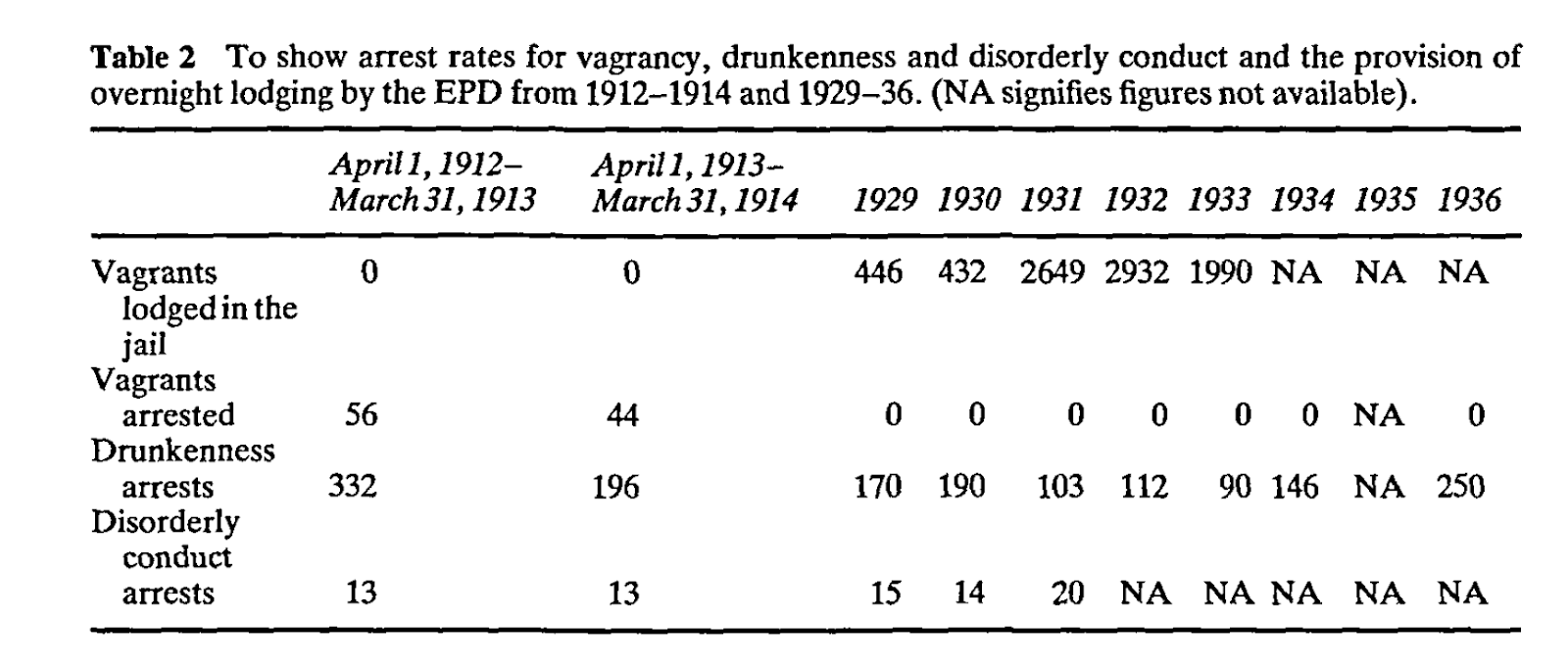
But though the city was relatively quiet throughout the 1930s, there were a couple of key developments during the decade that would have a lasting impact on the city’s future.
First was the consolidation of local newspapers. The Register-Guard was born in 1930, when Alton Baker purchased the Eugene Register for $244,000–about three million dollars in today’s money–and merged it with his existing Eugene Guard.
This left just two daily, non-student newspapers in a city that once had as many as a dozen.
“The Guard worked hard for the business community in Eugene, facilitated through Baker’s membership of the Eugene Chamber of Commerce and the Rotary Club,” Neil Websdale writes. “Between 1928-52 the Guard, Register and Register-Guard exerted a powerful influence over the voting decisions made by electors with regard to issues and candidate selection.”
The second major development began when the Eugene Police Department found itself implicated in a vice scandal. According to contemporary newspaper reports, EPD officers were well aware of at least five prostitution and gambling rings operating in the city. Despite this, they chose not to intervene, reportedly because at least one city councilor was on the take.
At the time, EPD officers were directly appointed and overseen by the city council – a system of patronage that was relatively prevalent in the U.S. during the early 20th century. This forced the officers to do the bidding of the city councilors that hired them, or risk losing their jobs.
Most of the time, this patronage system worked out just fine for all of the involved parties. But, in cases where city councilors were running criminal syndicates–or happened to be Klansmen–it had the effect of turning EPD officers into a publicly funded security force for crooked politicians.
Nadya Malinowska:
Huh. Imagine that.
The vice scandal of 1936 was EPD’s first major controversy and forced the city to drastically reform policing in the city. In May of that year, Eugene voters–82% of them, to be exact–decided to transition the department into more of a civil service method of policing, which was considered rather radical at the time.
Instead of the existing patronage model, in which officers were beholden to the city councilors who hired them, police officers were now required to take a civil service exam – the same one that other city employees, such as firefighters, had to take. The exam was supposedly designed to weed out potential crooks in the hiring pool and professionalize policing, separating it from the whims of local politicians.
But, as Dr. Websdale notes, that didn’t do much to help the root cause of the problem.
“Civil service, in and of itself, does not appear to have produced a police force that subsequently pursued gamblers. Gambling does not arise as a policing focus at the EPD in the years after 1936. Either all of the dens were closed for good in 1936, or some dens continued to operate perhaps somewhat more surreptitiously. Their existence has so far eluded the historical record… Whatever the civil service rules did to disconnect the hiring of police officers from ward councillors and whatever the [newspaper] articles did to sensationalize prostitution, the fact remains that bawdy houses (brothels) continued in Eugene in much the same form after 1936.”
Dr. Neil Websdale
But it didn’t really matter. By an overwhelming majority, Eugene’s citizens brought the idea of policing as a full-time job to the city.
Nadya Malinowska:
Only in Eugene could the police department fall ass-backwards into winning their autonomy by getting involved in a huge vice scandal.
Black, Brown, and White:
The Ferry Street Village and Early Struggles for Racial Justice
Mirroring much of the country, Eugene slowly recovered from the Great Depression thanks to the massive public works projects sponsored by the New Deal and the subsequent outbreak of World War II, which once again raised the price of Oregon timber.
Eugene’s economic recovery and newfound strategic importance in the eyes of the U.S. military led to a new boom in the city. The population increased by a whopping 72% between 1940 and 1950, while government investment in infrastructure and construction projects helped bring the city into the modern era.
More reforms followed, including the transition from the mayor-council form of local government to the current council–manager arrangement, in which an unelected City Manager was tasked with handling the day-to-day affairs of the city. This turned the position of Mayor into a largely ceremonial role at the head of the city council and gave exclusive administrative authority over personnel, departments, and finances to the holder of an unelected office hired by the city council.
Eugene, Springfield, and Lane County also formed the Central Lane County Planning Commission to map out the expansion and modernization of the rapidly growing city. Roads were paved, buildings were improved, and new bridges across the Willamette were built.
And it was the construction of one of these new bridges that brought Eugene face-to-face with its own racism.

In 1945, the city’s small Black population, unable to find housing due to strict racial discrimination laws, formed Eugene’s first Black neighborhood: the Ferry Street Village.
Located on the north bank of the Willamette River—where Alton Baker Park now sits—the neighborhood was home to around 100 residents, of whom about 60 or so were Black.
Four years later, the county evicted the residents and sent bulldozers to destroy the neighborhood in order to build the Ferry Street Bridge.
Nadya Malinowska:
Remember that the next time you decide to play disc golf or ride your bike through Alton Baker.
This left the city’s Black population with three options, according to local historian Chrisanne Beckner. Those with decent incomes moved to the area around 3rd Ave. and High St., where the historic Mims House–a former safe haven for Black travelers passing through the Northwest–is located. Those with meager incomes moved to Glenwood, where the rent was cheap due to the annual river flooding. The rest were forced to live in a muddy shantytown on what is now Sam Reynolds St. at the far-end of West Eugene, where there was no running water, electricity, or sewage systems.
It remained this way for three years, until a group of Black and white citizens formed the Lane County Fellowship for Civic Unity in 1952.
The LCFCU was led by three prominent local leaders: Pearlie Mae Washington, attorney H.V. Johnson, and Father Edmund Murnane. Washington was the matriarch of one of the first Black families to settle in Eugene, while Johnson and Murnane–who were both white–wielded considerable influence in the city.
The three leaders, along with roughly 200 other citizens, set out to force the city to address its housing and employment discrimination issues. But the LCFCU did not organize protests, nor were they particularly interested in leading marches.
Instead, they spent every single day going door-to-door in the city’s segregated neighborhoods and simply asked people to act decently and fairly toward their fellow Eugeneans. They authored reports and conducted studies about biased hiring practices in the city and presented those to anyone who would listen. They got community members to write letters to the Register-Guard pointing out blatant instances of racism and discrimination toward the city’s Black population.
This, somewhat surprisingly, ended up being an effective strategy. By 1953, most of the city’s neighborhoods had been legally integrated, and the LCFCU began to note an uptick in the hiring of Black people by local businesses – though the battle to end discrimination and racism in Eugene was far from over.
LCFCU continued to work on behalf of the city’s Black population through the end of 1950s and into the early 1960s before disbanding sometime around 1964.
Nadya Malinowska:
The few articles and research papers I read about Civic Unity give a lot of credit to Father Murnane and H.V. Johnson’s high degree of clout in the city for the group’s effectiveness in integrating Eugene’s neighborhoods. While there’s likely some truth to this, it’s also quite problematic for white people to give credit to other white people for fighting racism – especially when most of the written history conveniently ignores the contributions of the Black families that had been trying to survive in the city since the 1930s.
But I’d like to propose an alternative theory for the success of Civic Unity, one that neither ignores the contributions of Black women like Pearlie Mae Washington nor awards undue credit to old white men.
Civic Unity was able to succeed so quickly because they, as a group, confronted people directly in one-on-one and small group situations. They were able to speak directly to the city’s rapidly growing liberal population and tell them to their faces that their ignorance of reality led to unjust and downright abhorrent conditions for the fellow neighbors, and provided evidence, too.
It’s as if Civic Unity understood that the people of Eugene did not need to be educated about the impacts of racism and discrimination – they just needed their feet held to the flames of their own liberal guilt.
Thanks for reading–we wouldn’t have attempted such an expansive project if we didn’t believe that there was some merit to learning about the history of a place, both good and bad.
If you like what we do and would like to support future endeavors, please consider becoming a subscriber through Patreon. Your support means the world to us, and really helps us achieve our goal of becoming a fully independent alternative news source for Eugene, Lane County, and beyond.


.jpg#/media/File:Ferry_Street_Bridge_(Eugene,_Oregon).jpg)
I was born and have lived most of my 66 years in this area, and I’m really enjoying this educational series.
I pride myself in being fairly knowledgeable about our history, but the articles are bringing to light chapters that were either entirely unknown to me or criminally underreported. Thank you for correcting the public record.
However, please tone down the pink text boxes. They are simply too vivid and obscure the words and links they contain.
Thank you for recognizing Pearlie Mae Washington in your article. She is too often left out of the history of Black families in Eugene. The Washington’s also provided safety for Black travelers passing through this area including multiple Black entertainers. Thank you.